
Sunday, March 23, 2008



Friday, March 21, 2008
From Archbishop Daniel Buechlein's latest column
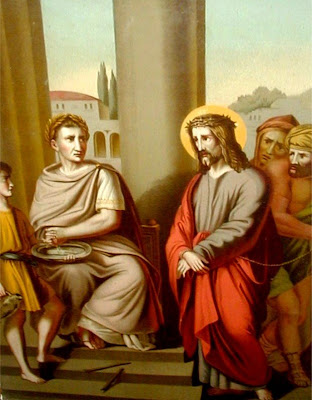
What makes for good religion? What makes for good worship in our churches?
Are soul-stirring sermons and rousing hymn-singing the key to salvation? Are people who attend a heartwarming Holy Week concert of sacred music more likely to be saved than those who gather for Easter Mass at one of our smallest mission churches? ...
The mystery of Jesus Christ which we celebrate is much more profound than what we do with it in word and song. Word and song is important, but the mystery is essential.
The drama of Holy Week warms the soul. Three special days—the Triduum of Holy Thursday, Good Friday and the Easter Vigil—are filled with the drama and pathos of our salvation, which culminates at the great Easter celebration...
Sensing the pathos of the suffering of Jesus and getting in touch with our sorrow and our need to repent because our sins brought him to such suffering is part of good liturgy. And so are the good Easter feelings, knowing that after all is said and done we have been saved.
But good worship and good religion is much more than soul-stirring feelings that may fade by Easter Monday morning. I think most of us realize that if we had to depend on feelings to move us to do what we need to do (and not do) in order to be saved, most of us would be in trouble much of the time. Good worship (and good religion) therefore is more than good feelings.
We need visible signs that somehow make present even now what was more than dramatic play-acting during his Passion, death and resurrection while Jesus Christ was on Earth.
We believe that Jesus founded the Church so that the mystery of his life and death can be carried on even as he sits at the right hand of the Father. We believe he gave us the sacraments to make his mystery of salvation present even now.
Good religion and good worship means we give our love to God. We go to church to give thanks and not just to get some good feelings.
Again, there is nothing wrong with good feelings, and our challenge is to plan our liturgical celebrations in such a way that we are emotionally moved as well. But we need to go deeper in our minds and hearts to embrace the wondrous mystery of our salvation present to us even now.
Thursday, February 28, 2008
The Basics of Conscience pt. I
The Three Dimensions of Conscience
1. Awareness (of the existence of a moral choice)
2. Examination (of one's conscience and of the available options)
3. Judgment - Action (making the most moral choice and acting upon it)
Erroneous Conscience - when you use your conscience but it is not properly formed and thus leads you to an immoral decision (or to a moral decision for the wrong reason)
Lax Conscience - your conscience is properly formed, but is underused. That is, you omit the first two dimensions of conscience and jump to number 3.
Informed Conscience - what your book calls a properly formed conscience, which is one that is educated and developed by constant use and examination.
Tuesday, February 12, 2008
For Black 1, Especially Luke
 The primate in question is the common marmoset (right), NOT the pygmy marmoset (left) which fits in the palm of one's hand.

Below is the brief story from the Smithsonian, entitled the "Evolution of Sharing".
Common marmosets display what researchers in Zurich call "unsolicited prosociality"—that is, they will slide a tray of food to a marmoset in a nearby cage even if there's no chance of getting something in return, and even if the other animal is unrelated. So far, they're the only animals other than human beings known to be so altruistic. Whether they say "Please" and "Thank you" is unknown.
Test 1 Study Guide
Morality Study Guide – Unit 1
Spectrum of Truth: Relativism vs. Absolutism
Jesus is the Source and Model of Truth for Christians
Know the main points from the Sermon on the Mount
a. focus on the Spirit rather than the Letter of the Law
b. Beatitudes
c. Teaching on prayer, fasting, almsgiving, judging, wealth, and dependence on God
Ecclesiology – the study of the nature, mission, and efforts of the Church
Ekklesia – assembly, people called by God
Mission – to bring about the kingdom of God (where His will is obeyed)
Method – preaching, prayer, & service
The Church stands as a vehicle for communicating Christ’s Moral Authority to mankind. This task is entrusted to the Magisterium – the teaching authority of the Church which resides in the bishops, preeminently in the bishop of Rome, the Pope.
The Magisterium communicates its moral authority through a number of sources:
a. Scripture (recall that it was the Magisterium that determined which books were par of the Canon of Sacred Scripture.
b. Catechism – a book of Catholic Doctrine. The Universal Catechism is the most comprehensive and most recent
c. Apostolic (Papal) writings
1. Apostolic Constitutions (most “weighty”)
2. Encyclicals and other decrees
d. Ecclesial Documents – writings from Vatican “departments”, national bishops’ conferences, and individual bishops.
Natural Law & its implications
Precepts of the Church
Sunday, February 3, 2008
The Church as Vehicle of Moral Teaching
I. Ecclesiology - the study of the nature and mission of the Church.
As part of his continuing mission fo the salvation of humanity Christ established his Church to teach, govern, and sanctify humanity.
A. The Nature of the Church is that of an "Ekklesia", Greek for "assembly".
An assembly consists of people called together by someone for a purpose. The Church is "People Called by God."
B. The Mission of the Church, the purpose for which it is called, is to bring about the Kingdom of God. Note that the Kingdom of God is a state in which God's will is given due respect as supreme authority and is obeyed rather than the will of man.
C. The Method the Church uses to build up the Kingdom of God is three-fold, corresponding to the three-fold nature of the Christian as Priest, Prophet, and King. Thus the Church's efforts consist of Prayer, Preaching, and Service.
D. The Organization of the Church is hierarchichal, led by the pope, successor of St. Peter and Vicar of Christ. He is advised and assisted by the college of Cardinals. Locally each diocese is led by a bishop, who is a spiritual descendant of the Apostles themselves. They are the chief shepherds of the flock they are called to serve. They are aided by priests and deacons in their apostolic ministry.
II. The Communion of Saints - this is the idea that membership in the Church transcends time and space. We are at one with all of our brothers and sisters in Christ regardless of how much time or physical distance separates us. The "spiritual" division of the Church is as follows:
A. Church Militant - as the name implies, these are members of the Church engaged in the battle against sin and evil, and is comprised of the souls here on earth.
B. Church Suffering - these are the souls suffering the pains and consequences of earthly sin, namely the souls in Purgatory where they await purification and entrance into heaven. They are aided by our prayers and charitable works when offered on their behalf.
C. Church Triumphant - this is the portion of the Church that has triumphed over sin and evil and enjoys the beatific vision of God in Heaven. These are the souls tha we know officially as "saints", both named and anonymous. Their intercessory prayers, as well as their example, are of benefit to us in our life of discipleship.
We will investigate exactly how the Chruch serves as a vehicle of moral authority next time, and there will be yet another Powerpoint posted on Weblcocker.
Until then,
Ad Jesum per Mariam,
Mr. B.
Jesus Christ, Source & Model of Christian Morality
Chapter 2 in your text examines the public ministry of Christ as the source of our moral authority. A few noteworthy nuggets:
a. Christology - the study of the nature(s) of Christ.
b. Doctrine of the Incarnation - The Church teaching that God became man in the person of Jesus Christ. He possesses both divine and human nature simultaneously.
c. Jesus became man so that we might have a share in the divine nature.
d. He accomplished the salvation / redemption of mankind through his sacrifice on the cross and subsequent resurrection, collectively known as the Paschal Mystery.
e. Prior to the Paschal Mystery, Christ spent approximately three years publicly preaching, healing, and performing miracles.
d. The quintessential preaching of Christ is that found in the Sermon on the Mount (or "on the plain" in Luke's Gospel). The Powerpoint notes on this sermon will be posted on Weblocker.
e. Christ's moral teaching is encapsulated in the "Greatest Commandment", to Love God above all else and to Love one's neighbor as one's self. (Christian Morality stands in contrast to Jewish morality at the time of Christ which was highly rigid and legalistic.)
Until next time,
Ad Jesum per Mariam.
Mr. B
Subscribe to:
Posts (Atom)

